
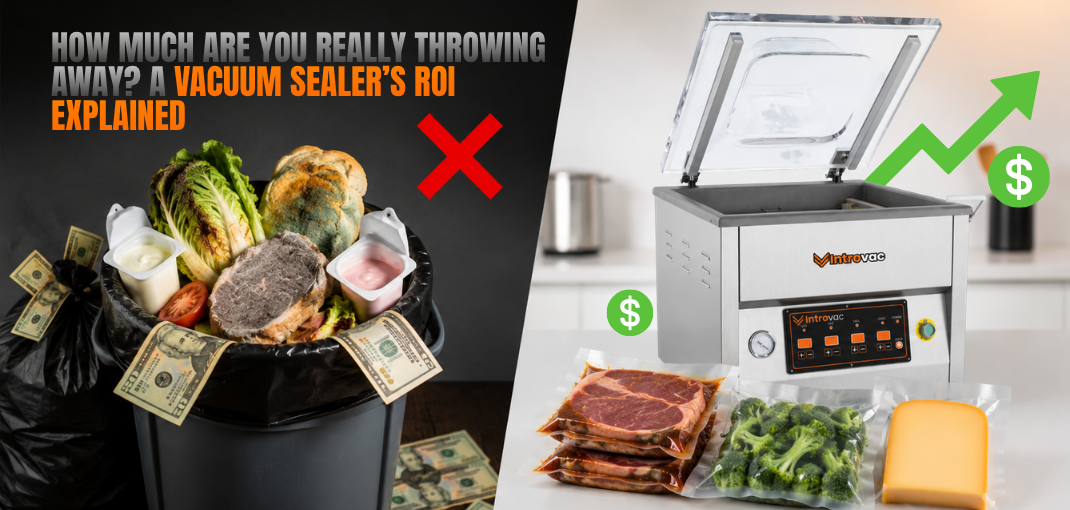
Open your fridge right now. Somewhere in there is a container of something you meant to eat three days ago, a bag of vegetables going soft at the edges, or a piece of meat that’s been pushed to the back and forgotten. Multiply that across every week of the year, and the number gets uncomfortable fast.
Most people underestimate how much food waste actually costs them. Not by a little by a lot. And once you see the real number, the case for a vacuum sealer stops being about “keeping food fresh” and starts looking like a straightforward financial decision.
This article walks through exactly how much the average household wastes, why it happens, and the real math behind whether a vacuum sealer earns back its cost and how fast.
The Real Number: How Much Food Waste Actually Costs You
Most estimates land in a similar range, and none of them are small. Depending on household size and location, the average family spends somewhere between roughly $1,300 and $1,800 every year on food that ends up in the trash rather than on a plate. Some studies that account for a full four-person household and higher grocery spending put the figure closer to $1,800–$1,866 annually.
Zoom out further and the picture gets even starker. Globally, households are estimated to lose close to a trillion dollars a year to food that’s bought and never eaten. In the United States alone, wasted food is estimated to cost several hundred billion dollars annually across the entire supply chain and households are responsible for roughly a third to nearly half of that total, more than restaurants, retailers, or farms individually.
Broken down to a single household, researchers commonly point to a simple, sobering fact: the average American household throws away close to a third of the food it buys. That’s not spoiled leftovers or freezer-burned mystery meat only it’s produce, dairy, bread, and meat that was perfectly fine days earlier and became unusable simply because it wasn’t stored properly or used in time.
Where Does All That Wasted Food Actually Go?
It helps to know where the losses concentrate, because it tells you exactly where a vacuum sealer makes the biggest difference.
- Fruits and vegetables make up a large share of household food waste, roughly 40% by some estimates, largely because they spoil the fastest in ordinary storage.
- Bread and cereals account for a meaningful chunk too, often around one-fifth of what’s thrown out.
- Meat, poultry, and dairy are lower in volume but disproportionately expensive to waste, a forgotten steak or unused block of cheese costs far more per pound than a wilted lettuce leaf.
- Overbuying is one of the single biggest drivers. A large share of household food waste, commonly cited around 60% in some markets comes from simply buying more than gets used before it spoils, not from cooking failures or spoiled deliveries.
None of this is really about carelessness. It’s about the gap between how fast fresh food naturally deteriorates and how fast a household actually consumes it. That gap is exactly what a vacuum sealer is built to close.
Why Vacuum Sealing Actually Solves This (Not Just “Helps”)
Food spoils for a few predictable reasons: exposure to oxygen, moisture loss, and the growth of bacteria and mold that thrive in normal air. Vacuum sealing addresses all three directly by removing the air a package is stored in, which slows oxidation, prevents freezer burn, and creates an environment where spoilage organisms struggle to grow.
The shelf-life difference isn’t marginal it’s dramatic:
- Meat, poultry, and fish, which typically last around six months to a year in a standard freezer bag, can last two to three years when properly vacuum sealed.
- Fresh produce that lasts only a handful of days in the fridge can often be extended to one to two weeks vacuum sealed, and much longer in the freezer.
- Cheese, which spoils in about one to two weeks in ordinary storage, can last four to eight months vacuum sealed.
- Dry pantry goods like flour, rice, pasta, and cereal items with a normal shelf life of around six months can extend out to a year or two when air is properly removed.
Put simply, vacuum sealing commonly extends food shelf life by three to five times compared to standard storage methods. That’s not a marginal improvement it’s the difference between food you have to use this week and food that’s still good to eat months from now.
The ROI Math: What a Vacuum Sealer Actually Saves You
Here’s where the financial case becomes concrete. Let’s use a conservative, real-world estimate.
Assume:
- Average household food waste: $1,500/year
- A table top or chamber vacuum sealer costs somewhere between $60–$250 depending on the model (single chamber and double chamber machines sit at the higher end, given their build and capacity)
- Even a modest reduction in waste say, cutting your food waste in half through better storage saves roughly $750/year
The math:
- A mid-range vacuum sealer purchased for around $150 pays for itself in under three months if it cuts your food waste by even half.
- Every month after that is pure savings typically $60–$120/month depending on household size and grocery spend.
- Over a single year, most households recover their entire investment several times over.
This is before accounting for the added savings of buying in bulk (which vacuum sealing makes far more practical, since bulk-bought meat, produce, or pantry goods no longer need to be used immediately to avoid spoilage) or the time saved from fewer emergency grocery runs to replace something that spoiled early.
Table Top vs Single Chamber vs Double Chamber – Which One Fits Your Waste Problem?
The right machine depends on how much food you’re actually trying to save and how often.
Table Top Vacuum Sealer Best suited for smaller households or lighter usage sealing leftovers, a few cuts of meat, or pantry staples every week or two. If your food waste problem is mostly produce and small portions, this is usually the most cost-effective entry point.
Single Chamber Vacuum Sealer A step up for households that cook in bulk, meal-prep regularly, or buy meat and produce in larger quantities to save on grocery costs. Because chamber sealers handle liquids and marinated foods without the sealing failures common in basic machines, they tend to get used more consistently which matters, since a vacuum sealer only saves money if it actually gets used.
Double Chamber Vacuum Sealer Makes sense for larger households, families that do serious bulk buying (think whole cuts of meat, seasonal produce hauls, or big-batch meal prep), or anyone essentially running a small home food operation. The higher upfront cost is easily justified by higher-volume waste prevention.
If you’re unsure, the honest answer is: the model that fits your actual waste pattern always wins, not the most expensive one. A single person who wastes $50/month on forgotten produce doesn’t need the same machine as a family of five bulk-buying meat every month.
Beyond Money: The Environmental Side of the Equation
The financial case is strong enough on its own, but it’s worth noting the broader impact too. Wasted household food doesn’t just disappear it typically ends up in a landfill, where it breaks down without oxygen and produces methane, a greenhouse gas with a significantly higher short-term warming impact than carbon dioxide. Households globally are responsible for a meaningful share of food-system methane emissions, and food waste is consistently one of the largest single categories of material entering landfills in developed countries.
Cutting your own household waste by half doesn’t just save money it measurably reduces your household’s environmental footprint at the same time, with no extra effort required beyond storing food properly in the first place.
Signs You’re Losing More Money to Food Waste Than You Realize
A few quick checks to see where you stand:
- You regularly throw away produce that went bad before you got to it
- You buy meat in bulk “to save money” but end up freezing it in ways that lead to freezer burn
- You’ve thrown out bread, cheese, or leftovers that were simply forgotten
- You avoid buying in bulk because you’re worried food will spoil before you use it all
- You’ve noticed your grocery bill creeping up without your actual eating habits changing
If two or more of these sound familiar, you’re very likely in the range of the $1,500/year average and a vacuum sealer is one of the few kitchen purchases with a genuinely fast, measurable payback period.
Frequently Asked Questions
How much money does the average household waste on food each year? Estimates commonly range from about $1,300 to $1,800 per year for a typical household, with some studies citing figures closer to $1,866 when accounting for full grocery spend.
Does a vacuum sealer actually pay for itself? Yes, in most cases relatively quickly. A mid-range vacuum sealer often pays for itself within a few months if it meaningfully reduces spoilage, since the average household loses well over a thousand dollars a year to wasted food.
How much longer does vacuum sealed food actually last? On average, three to five times longer than food stored using standard methods. Meat and fish can go from lasting several months in the freezer to lasting two to three years when properly vacuum sealed.
Is a table top vacuum sealer enough, or do I need a chamber sealer? For smaller households and lighter, everyday use, a table top sealer is usually sufficient. If you cook with marinades, buy in bulk, or want more consistent seals over time, a single or double chamber sealer is the better long-term investment.
Does vacuum sealing help with more than just meat? Yes. Produce, cheese, bread, and dry pantry goods like rice, flour, and pasta all see meaningfully extended shelf life when properly vacuum sealed, not just proteins.
The Bottom Line
Food waste isn’t a minor inefficiency for most households, it’s a genuine, recurring financial loss that quietly adds up to well over a thousand dollars a year. The good news is that it’s one of the most fixable expenses in a household budget, and the fix doesn’t require a lifestyle overhaul. It requires storing food in a way that actually matches how fast you use it.
A vacuum sealer isn’t a gadget that sits in a drawer used consistently, it’s one of the few kitchen purchases that pays for itself within months and keeps paying for itself every month after that. Whether a table top, single chamber, or double chamber model makes sense depends on your household’s size and habits, but the underlying math holds up across all three: less waste, lower grocery bills, and food that actually lasts as long as you need it to.