
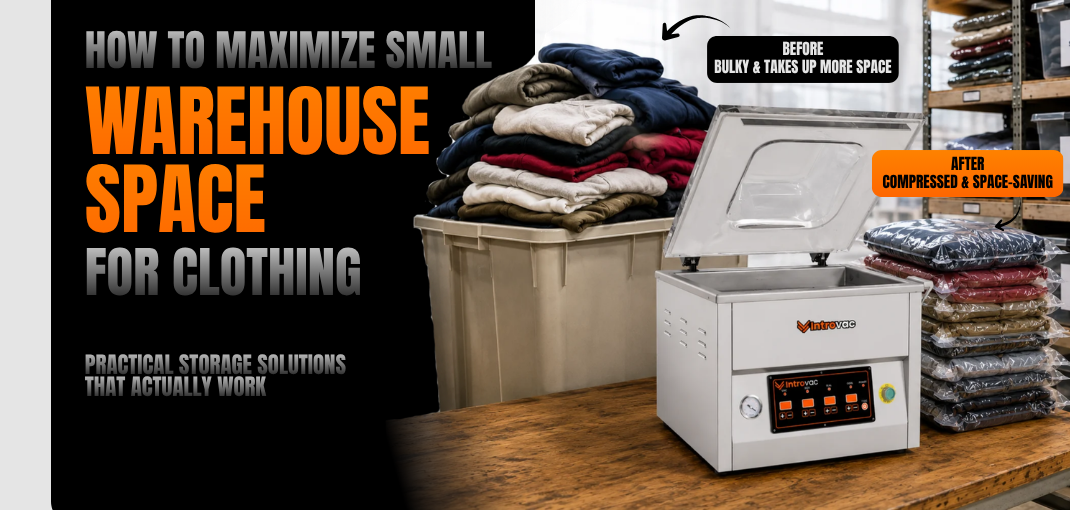
Running a small warehouse can be challenging when the products you store are bulky, soft, and difficult to stack efficiently and clothing is a perfect example. A few boxes of folded shirts may not seem like a problem, but add coats, jeans, sweatshirts, jackets, blankets, uniforms, seasonal clothing, or donated garments, and storage space can disappear surprisingly quickly. Traditional bins and shelving may be completely adequate when inventory levels are low, but once clothing starts arriving in larger quantities, the real problem becomes volume rather than weight.
For clothing donation centers, resale organizations, textile businesses, apparel distributors, charities, disaster-relief organizations, and small warehouses, finding a way to store more clothing without renting additional space can make a significant difference. One practical solution is to combine better warehouse organization with vacuum compression and vacuum packaging for soft goods. Vacuum packaging removes much of the air trapped between layers of fabric, allowing suitable clothing and textile products to become more compact making it easier to organize inventory, use bins and shelves more efficiently, and make better use of a limited warehouse footprint.
This guide explains how to maximize small warehouse space for clothing, when vacuum compression makes sense, how to organize compressed garments, and how to determine whether a commercial vacuum sealer is appropriate for your operation.
Why Clothing Takes Up So Much Warehouse Space
The first step toward solving a storage problem is understanding what is actually consuming your space. With clothing, it is often not the material itself it is the air and empty space surrounding the material.
A folded sweatshirt contains layers of fabric with air trapped between them. A winter coat is even bulkier because of insulation, lining, pockets, padding, and construction. Jeans are relatively dense, but when hundreds or thousands of pairs are stacked or placed into bins, the total volume becomes substantial. The same applies to blankets, towels, uniforms, bedding, sleeping bags, and other soft goods.
Traditional warehouse storage generally leaves some amount of unused space around these products, since clothing placed loosely into a bin does not conform perfectly to the available space. Instead, it creates gaps between individual garments and around the sides and top of the container. That means a warehouse can reach its apparent storage limit even though a significant amount of the available volume is technically occupied by air. This is one reason small warehouse space optimization requires more than simply purchasing additional shelves or bins you need to look at the volume of the inventory itself.
The Small Warehouse Problem: More Inventory, Less Usable Space
Small warehouses face a particular challenge. A large distribution center may have the option of expanding into another section, adding pallet racking, leasing additional space, or redesigning its storage layout. A small warehouse often does not have those options every square foot matters.
When clothing inventory begins overflowing from bins, several problems can develop:
- More floor space becomes occupied
- Walkways become narrower
- Bins become difficult to access
- Employees spend more time searching for inventory
- Seasonal clothing becomes harder to separate
- Overstock ends up in temporary storage areas
- Additional shelving or containers become necessary
- The warehouse may eventually need more space
This problem can become particularly noticeable in clothing donation centers. Donations rarely arrive in perfectly standardized packages one shipment may contain coats, another jeans, and another sweatshirts or mixed clothing, with some items individually folded and others loosely packed. If the facility uses a bin-style storage system, bulky garments can quickly consume the available capacity.
Instead of asking only “How can we add more storage bins?” it is worth asking, “How can we reduce the volume of the clothing going into those bins?” That change in thinking can make a major difference.
Start With Warehouse Organization Before Buying More Equipment
Vacuum compression can help reduce clothing volume, but equipment should not be the first step in every warehouse. Start by examining your current storage system how clothing enters the facility, how it is sorted, how it is packaged, and how long it remains in storage.
For example, separate clothing into practical categories such as coats and jackets, jeans and pants, sweatshirts and sweaters, shirts, uniforms, seasonal clothing, bedding and blankets, emergency supplies, clothing awaiting distribution, and clothing awaiting resale or processing. Then determine which categories consume the most physical space. You may discover that your biggest problem isn’t everyday inventory it may be winter coats or sweatshirts that sit in storage for several months. That is where compression can become especially useful.
What Is Vacuum Compression for Clothing?
Vacuum compression is a packaging method that removes air from a sealed bag containing a suitable soft product. The basic process is straightforward: clothing is placed into a vacuum-compatible bag or pouch, the air is extracted using a vacuum packaging machine, and the package is sealed. As air is removed, the clothing compresses, resulting in a more compact package that can be easier to stack, organize, transport, and store.
Vacuum-sealed clothing storage is already commonly used for bulky soft items such as clothing, bedding, and other textiles, because removing air can significantly reduce the space these products occupy. For a small warehouse, the important concept isn’t simply “vacuum sealing” it’s volume management. If you can reduce the volume of suitable clothing before placing it into your storage system, you may be able to fit more usable inventory into the same physical area.
How Vacuum Packaging Can Help a Small Clothing Warehouse
The biggest potential benefit is simple: less volume per package means more efficient use of available storage space.
Imagine your warehouse has a limited number of bins, and you currently place loose sweatshirts into those bins until each one is full. Now imagine grouping suitable garments into vacuum bags and removing the trapped air before storing them. The compressed packages can occupy less volume than loosely packed garments, allowing you to rethink how the same bins, shelves, racks, or floor areas are used.
The exact amount of compression will vary. A thin cotton shirt will behave differently from a heavily insulated winter coat, and a pair of jeans will behave differently from a fleece sweatshirt. Because of this, don’t design your warehouse around a theoretical percentage reduction instead, test your actual clothing inventory. Take a representative group of garments, package them, measure the original storage volume, and compare it with the compressed package. That gives you a much more useful number for your specific operation.
Which Clothing Items Are Best for Vacuum Compression?
Not every product needs to be vacuum packaged. Vacuum compression is particularly effective for soft, flexible, compressible products.
Coats and jackets. Bulky winter coats can consume a considerable amount of storage space because of insulation, padding, and layers of material. For seasonal storage, compression may help reduce their footprint considerably.
Sweatshirts and hoodies. Sweatshirts are highly compressible because they contain a lot of fabric and trapped air. Large quantities of hoodies and sweatshirts can quickly fill storage bins, making them a strong candidate for space-saving packaging.
Jeans and pants. Jeans are heavier and denser than sweatshirts, but large quantities still require significant storage space. Vacuum packaging can help create more consistent, compact packages that are easier to organize.
Blankets. Blankets are among the most obvious candidates for compression because their large surface area and fluffy construction create substantial volume.
Uniforms. Organizations storing uniforms for employees, schools, security companies, military applications, or emergency services may benefit from compact packaging, especially for seasonal or reserve inventory.
Towels and linens. Hospitality, healthcare, laundry, and institutional operations often have to store large quantities of soft textile products. Compression can help when conventional folding and stacking methods leave too much unused space.
Don’t Treat Every Garment the Same
One common mistake is assuming that every clothing item should be vacuum sealed in exactly the same way that isn’t practical, because different garments have different compression characteristics. A lightweight sweatshirt may compress easily, while a thick winter coat may require a larger bag and more careful loading. A structured garment may not be suitable for aggressive compression if maintaining its shape is important.
The goal is not to compress everything as much as physically possible. The goal is to find the right level of compression for your storage requirements and the condition of the garments. For donated clothing, this distinction can be especially important if the garments will later be sorted, inspected, distributed, or sold, packaging should support your workflow rather than create additional work.
How to Organize Vacuum-Packed Clothing in Bins
If your warehouse already uses bin-style storage, vacuum packaging doesn’t mean you need to completely replace the system. In many cases, the better approach is to integrate compressed packages into the existing layout. For example, instead of placing loose sweatshirts directly into a large bin, you could organize them into labeled compressed packages, each containing a defined category such as “Men’s Sweatshirts Large/XL Winter” or “Women’s Coats Winter Donation Batch 2026.”
This creates a more structured storage system. The packages can then be arranged according to clothing type, size, season, gender/category where relevant, donation batch, distribution destination, or inventory status. Clear labeling is important because the goal of space optimization isn’t simply to fit more clothing into the warehouse you also need to be able to find the clothing later.
Use Standard Package Sizes Whenever Possible
One of the simplest ways to improve storage efficiency is to standardize your packaging. If every package has a different shape and size, stacking becomes difficult. Whenever practical, use consistent bag sizes and establish simple loading guidelines for example, a small package for shirts, a medium package for jeans or sweatshirts, and a large package for coats or blankets. The exact sizes should depend on your products and equipment.
Standardization can make your storage system more predictable and can help you estimate how many packages fit into each bin or storage zone particularly useful for small warehouses where every inch of available space matters.
Vertical Storage Still Matters
Vacuum compression is not a replacement for good warehouse layout; it works best as part of a larger space-optimization strategy. If you have already reduced the volume of your clothing, look at how effectively you are using the vertical space above the floor. Many small warehouses focus heavily on floor area while leaving valuable vertical capacity underused. Warehouse-space optimization strategies commonly recommend evaluating vertical storage, container dimensions, shelving, and layout rather than focusing exclusively on floor space.
For compressed clothing packages, this may make it easier to create organized stacks or shelving zones. The important point is to maintain safe stacking practices and ensure that employees can access packages without creating unnecessary handling risks.
Vacuum Packaging vs. Traditional Clothing Storage
Traditional storage isn’t necessarily wrong it’s simply not always the most space-efficient option.
Traditional storage: Clothing is folded and placed directly into plastic bins, cardboard boxes, shelves, racks, or pallets. The clothing remains relatively fluffy, and air remains trapped throughout the package.
Vacuum storage: Clothing is placed into a suitable vacuum bag, air is removed, and the clothing compresses. The package becomes more compact and can potentially be stored more efficiently.
The right approach depends on your operation. If clothing is constantly being picked and distributed individually, vacuum packaging every item may slow your workflow. But if large quantities are being stored for weeks or months, compression may provide much greater value.
When Should You Vacuum Pack Clothing?
A useful rule is to focus on slow-moving and bulky inventory. For example, a donation center may receive hundreds of winter coats during a period when they are not immediately needed. Rather than allowing those coats to occupy maximum volume for months, they could potentially be compressed and organized for later distribution.
The same principle can apply to seasonal clothing, emergency reserves, overstock, backstock, disaster-relief supplies, clothing awaiting distribution, bulk donations, long-term inventory, promotional apparel, and uniform reserves. The faster an item needs to be accessed, the more carefully you should consider whether vacuum packaging fits your workflow.
How to Calculate Your Potential Storage Savings
You don’t need sophisticated software to estimate whether compression could help. Start with a simple test:
- Select a representative batch for example, 20 coats, 30 sweatshirts, and 50 pairs of jeans.
- Measure the current storage volume record how much space the clothing occupies in your existing bins or storage area.
- Vacuum package the same inventory using a suitable bag and vacuum packaging setup.
- Measure the compressed volume by placing the packages in the same storage area and measuring the space they occupy.
- Compare the results using the formula: Volume reduction = (Original volume − Compressed volume) ÷ Original volume × 100.
For example, if a group of garments originally occupies 10 cubic feet and the compressed packages occupy 6 cubic feet, that’s a (10 − 6) ÷ 10 × 100 = 40% volume reduction. Your actual result may be higher or lower depending on the garments the important thing is that you’re using your own inventory data rather than relying on a generic claim.
Don’t Forget the Cost of Additional Warehouse Space
When evaluating a storage solution, many businesses focus only on the price of equipment or packaging materials. A better calculation includes the cost of your current warehouse constraints. Ask yourself:
- How much does additional warehouse space cost?
- How much are additional bins costing?
- How much employee time is spent reorganizing storage?
- How often are storage areas rearranged?
- How much inventory is currently sitting outside designated storage?
- How much space is being consumed by seasonal clothing?
- How much additional capacity would you gain from compression?
A vacuum packaging system doesn’t have to eliminate the need for additional space entirely to provide value. If it helps you postpone a warehouse expansion, reduce the number of storage containers required, or increase usable capacity in your current facility, it may justify the investment.
Choosing a Vacuum Sealer for a Small Warehouse
Not every vacuum sealer is designed for the same workload. A household vacuum storage system may be perfectly adequate for occasional use at home, but a warehouse processing hundreds of packages needs to think differently. Important factors include:
Chamber size. The chamber needs to accommodate the bags and products you plan to package. If you are working with bulky coats or blankets, chamber dimensions become especially important.
Pump performance. The vacuum system needs to remove air efficiently and consistently. For repetitive commercial work, consistent performance matters more than simply having a high vacuum specification on paper.
Seal quality. A strong, consistent seal is critical if packages lose their seal, the product can expand again and the storage-space benefit may disappear.
Duty cycle. Consider how frequently the machine will operate. A machine designed for occasional household use may not be the right choice for a warehouse processing packages throughout the day.
Bag availability. The packaging material is just as important as the machine. Choose vacuum-compatible bags or pouches that are appropriate for your products and intended storage conditions.
Ease of operation. If several employees will use the machine, straightforward controls and repeatable operating procedures can make a significant difference.
Can a Small Warehouse Use a Commercial Vacuum Sealer?
Yes. In fact, small warehouses can be among the most practical environments for commercial vacuum packaging because they have a strong incentive to maximize existing space. You don’t necessarily need a huge industrial packaging line a smaller operation may need a reliable machine that can handle its daily workload without taking up excessive floor space. This is one area where an appropriately sized commercial vacuum sealer can make sense. The goal is to match the machine to the workload rather than automatically purchasing the largest system available.
What About a Home Vacuum Sealer?
For very small quantities, a household vacuum sealer may be enough for example, someone storing a few bags of seasonal clothing at home may not need commercial equipment. But warehouse requirements are different. A commercial environment typically involves higher daily volume, repeated operation, larger bags, more demanding workloads, multiple users, consistent sealing requirements, and greater expectations for durability. If you’re processing clothing regularly rather than occasionally, a commercial vacuum packaging machine may provide a more appropriate workflow particularly relevant to small businesses that are growing but aren’t ready for a large industrial packaging system.
A Practical Workflow for a Small Clothing Warehouse
A simple, repeatable workflow can make the technology much more useful:
- Receive, clothing enters the warehouse.
- Inspect, separate damaged, unsuitable, or contaminated items according to your organization’s procedures.
- Sort, organize clothing by category, season, size, or destination.
- Prepare, fold garments consistently and remove unnecessary packaging or foreign objects.
- Load, place an appropriate quantity into a vacuum-compatible bag.
- Vacuum, remove the air using the vacuum packaging machine.
- Seal, create a reliable seal.
- Label, clearly identify the contents.
- Store, place the compressed package into its designated bin, shelf, rack, or storage zone.
- Track, maintain an inventory system so employees know where each package is located.
This workflow keeps the focus on the actual warehouse problem rather than treating vacuum packaging as an isolated piece of equipment.
Important Considerations Before Vacuum Storing Clothing
Vacuum packaging is useful, but it isn’t appropriate for every garment or every storage condition. Before adopting it across your entire inventory, test a representative selection of products and consider the following:
- Fabric, some materials may respond differently to prolonged compression.
- Garment structure, structured or delicate garments may require special handling.
- Storage duration, packaging requirements can differ between short-term and long-term storage.
- Moisture, clothing should be clean and appropriately dry before being sealed.
- Accessibility, frequently handled items may be better stored using conventional methods.
- Wrinkles, compression can increase wrinkles in some garments, so consider whether appearance matters when the clothing is eventually opened.
The goal should always be to balance space savings with product condition and operational efficiency.
Beyond Clothing Donation Centers: Other Small-Warehouse Applications
Although clothing donation centers are a strong example, the same storage problem appears in many other businesses:
- Apparel resellers, businesses buying and reselling used or new clothing can use compact packaging for slower-moving inventory.
- Uniform suppliers, uniforms can occupy significant space when stored in multiple sizes and styles.
- Textile businesses, fabrics and soft textile products can create storage challenges when inventory levels increase.
- Disaster relief organizations, emergency clothing and blankets often need to be stored until they are needed.
- Hospitality businesses, hotels and similar operations may need to store large quantities of towels, bedding, and linens.
- Laundry operations, clean textile inventory can consume considerable storage space before distribution.
- E-commerce businesses, small online sellers may need to store substantial amounts of apparel in relatively small facilities.
In all of these situations, the underlying question is the same: how can we store more inventory without increasing our physical footprint?
Why Space Optimization Doesn’t Have to Mean a Bigger Warehouse
When storage space becomes tight, the natural reaction is to look for a larger facility but expansion isn’t always the best first step. Before taking on additional rent, consider whether you are using the existing space efficiently. Can you reduce the volume of bulky inventory, improve vertical storage, standardize package sizes, eliminate unused container space, reorganize slow-moving inventory, separate active and inactive inventory, compress suitable soft goods, or improve labeling and inventory tracking?
A relatively small operational change can sometimes unlock capacity that was already available. For a small warehouse, that can be much more attractive than immediately committing to additional square footage.
How Introvac Can Fit Into a Small-Warehouse Storage Strategy
Introvac focuses on vacuum sealing equipment designed to make vacuum packaging more accessible for commercial operations and demanding users who need a practical solution without jumping immediately to a large industrial packaging system.
For a small warehouse handling clothing, textiles, blankets, uniforms, or other suitable soft goods, an appropriately sized Introvac vacuum sealer can become part of a simple volume-reduction workflow. The important point is that the machine should be selected according to your actual products, bag dimensions, workload, and packaging frequency. If you are processing a few packages a week, your requirements will be very different from a donation center processing hundreds of garments every day.
Start with your workload, then determine the chamber size, bag size, sealing configuration, operating speed, and other features you actually need. That approach helps prevent a common mistake: buying equipment based on maximum theoretical capacity instead of real operational requirements.
A Simple Way to Decide If Vacuum Packaging Is Right for You
If you’re unsure whether vacuum packaging will make a meaningful difference, don’t start with a large equipment purchase start with a test. Choose one clothing category that causes the biggest storage problem, such as winter coats. Take a representative quantity and measure how much space it currently occupies, then package a similar quantity using vacuum-compatible bags and a suitable vacuum sealer.
Compare the original volume, compressed volume, number of packages, storage configuration, labor required, ease of access, and package integrity. If the results show a meaningful improvement, expand the test to sweatshirts, jeans, blankets, or other suitable inventory. This gives you real data from your own warehouse.
Frequently Asked Questions
How can I save warehouse space for clothing? Start by identifying bulky and slow-moving clothing, improving your storage layout, using vertical space effectively, standardizing storage containers, and considering vacuum compression for suitable soft goods. Vacuum packaging can reduce the volume of clothing and make existing storage space more efficient.
Can you vacuum pack clothes for warehouse storage? Yes. Suitable clothing and other soft goods can be placed in vacuum-compatible bags, air can be removed with a vacuum packaging machine, and the package can then be sealed. The suitability of the method depends on the garment, material, storage duration, and intended use.
What clothes are best for vacuum storage? Bulky, flexible, and compressible garments such as sweatshirts, coats, jackets, blankets, and some types of uniforms are often good candidates. Always test specific materials before applying the process to an entire inventory.
How much space can vacuum packing clothes save? There is no universal percentage because results vary significantly by garment type, material, loading method, bag dimensions, and vacuum process. The best way to determine your potential savings is to measure the original and compressed volume of representative inventory.
Is vacuum sealing good for clothing donation centers? It can be useful for donation centers that need to store large quantities of bulky clothing in limited warehouse space, particularly for seasonal inventory, reserve clothing, bulk donations, and garments that won’t need immediate access.
Can vacuum-packed clothes be stored in bins? Yes. Compressed packages can be incorporated into a bin-based storage system, provided the bags, packages, and bins are appropriately sized and the packages remain easy to identify and access.
Should I vacuum pack every piece of clothing? Not necessarily. Frequently accessed clothing may be better stored conventionally. Vacuum packaging is often more valuable for bulky, seasonal, slow-moving, or long-term inventory.
Is a commercial vacuum sealer better than a household vacuum sealer? For occasional household storage, a consumer machine may be sufficient. Businesses with repeated packaging requirements should consider equipment designed for commercial workloads, particularly when consistency, durability, chamber size, and repeated operation are important.
Can vacuum packaging protect clothing during storage? A properly sealed package can help limit exposure to dust and environmental contaminants. However, vacuum packaging should not be treated as a substitute for appropriate warehouse environmental controls clothing should be clean and dry before packaging, and storage conditions should still be properly managed.
Final Thoughts: Make Your Existing Warehouse Work Harder
A small warehouse doesn’t necessarily mean you have to accept limited storage capacity. Sometimes the answer isn’t another building, another room, or dozens of additional bins sometimes the better solution is to reduce the volume of what you’re already storing.
For clothing donation centers and other organizations dealing with coats, jeans, sweatshirts, blankets, uniforms, and other soft goods, vacuum compression can be one tool in a broader warehouse space optimization strategy. The most effective approach is practical: organize your inventory, identify your biggest space-consuming categories, measure the volume you currently use, test vacuum compression on representative products, and compare the results.
If the compressed packages give you more usable capacity without making your inventory difficult to access, you may have found a simple way to get more from the warehouse you already have. And for a small warehouse, making better use of the space you already pay for can be far more valuable than simply finding more space.