
Electronic components may look small and durable, but some of them can be surprisingly sensitive to moisture.
A semiconductor sitting safely inside its original packaging can appear perfectly fine. Yet if that component absorbs too much moisture before it reaches the assembly line, the problem may not become visible until it goes through the reflow soldering process.
That is where things can get expensive.
Moisture absorbed by a component can expand rapidly when exposed to the high temperatures used during soldering. In severe cases, this can cause cracking, delamination, package separation, or what the electronics industry commonly calls the “popcorn effect.” The result can be rejected boards, unreliable products, production delays, and unnecessary component waste.
This is why Moisture Sensitivity Level (MSL) packaging is such an important part of electronics manufacturing.
For manufacturers, contract assemblers, distributors, and electronics suppliers, proper MSL packaging is not simply about putting components inside a sealed bag. It involves controlling moisture exposure from storage and transportation through handling and assembly.
In this guide, we’ll explain what MSL means, which electronic components are moisture-sensitive, how MSL packaging works, how vacuum packaging fits into the process, and what manufacturers should consider when protecting components before assembly.
What Does MSL Mean in Electronics?
MSL stands for Moisture Sensitivity Level.
It is a classification used to indicate how sensitive an electronic component is to moisture exposure before it is subjected to soldering processes such as reflow.
The basic idea is straightforward:
The higher the moisture sensitivity, the more carefully the component needs to be handled and stored before assembly.
Moisture-sensitive components can absorb humidity from the surrounding environment. This moisture may not cause an immediate visible problem while the component is sitting in storage.
The real risk appears when the component is exposed to the elevated temperatures of reflow soldering.
During reflow, moisture trapped inside the component can turn into vapor and expand. Because the package is exposed to rapid temperature increases, the internal pressure can become high enough to damage the package structure.
This is why electronics manufacturers need to pay attention not only to how components are packaged, but also to how long they remain exposed to ambient conditions after opening their protective packaging.
Why Moisture Is a Problem Before PCB Assembly
Modern electronic components are becoming smaller, thinner, and more densely packaged.
That has created major advantages in electronics design, but it has also made certain components more vulnerable to moisture-related damage.
Components can absorb moisture through materials used in their construction, including molding compounds and other moisture-sensitive materials.
Before assembly, components may pass through several stages:
- Manufacturing
- Inspection
- Packaging
- Warehousing
- International shipping
- Distribution
- Incoming inspection
- Production-floor handling
- PCB assembly
- Reflow soldering
Every stage creates an opportunity for moisture exposure.
A component may be perfectly protected during shipping but then sit outside its moisture barrier packaging for several days in a humid production environment.
The original packaging alone does not guarantee protection if handling procedures are not followed after opening.
What Happens to Moisture-Sensitive Devices During Reflow?
The major concern with moisture-sensitive devices is the combination of absorbed moisture and high temperature.
Imagine a component that has gradually absorbed moisture while sitting in a humid environment.
At normal room temperature, there may be no obvious sign that anything is wrong.
Then the component enters the reflow oven.
Temperatures rise rapidly.
The absorbed moisture turns into vapor. Because vapor occupies much more volume than liquid water, internal pressure increases inside the component package.
Depending on the component construction and the amount of absorbed moisture, this pressure can contribute to:
- Internal cracking
- Package cracking
- Delamination
- Die or wire damage
- Separation between internal layers
- Soldering reliability problems
- Electrical failures
- Long-term reliability issues
Severe package cracking is commonly associated with the popcorn effect, because the component can literally crack or “pop” under thermal stress.
The damage isn’t always immediately obvious.
A component may pass an initial inspection and still have internal damage that affects its long-term reliability.
For manufacturers producing automotive electronics, medical devices, industrial controls, aerospace equipment, or other high-reliability products, that is a serious concern.
Understanding MSL Levels
MSL classifications are used to communicate how long a moisture-sensitive component can generally remain exposed to controlled ambient conditions after its protective packaging is opened, before it needs additional protection or processing.
The commonly referenced MSL levels range from MSL 1 through MSL 6.
The important point is that the levels represent different moisture sensitivity and handling requirements.
MSL 1
MSL 1 represents components with relatively low moisture sensitivity.
Under the applicable standard conditions, these components have a much longer allowable exposure period than higher-level devices.
That does not mean moisture protection is irrelevant. Proper storage and packaging are still important, particularly for long-term inventory and transportation.
MSL 2
MSL 2 components have greater moisture sensitivity and require more controlled handling after their protective packaging is opened.
Manufacturers need to pay attention to exposure time and storage conditions.
MSL 2a
MSL 2a introduces a shorter allowable exposure period than MSL 2 under the specified conditions.
This makes proper production-floor management increasingly important.
MSL 3
MSL 3 is commonly encountered in electronics manufacturing and requires significantly more attention to floor-life management.
Once the moisture barrier packaging is opened, exposure time begins to matter.
If components exceed their allowable exposure time, manufacturers may need to take corrective action before reflow.
MSL 4
MSL 4 components have a shorter floor life and therefore require tighter control.
Leaving these components exposed in an uncontrolled production environment can quickly create a moisture-management problem.
MSL 5 and MSL 5a
These components are highly moisture-sensitive and require particularly careful handling.
Manufacturers need reliable procedures for packaging, storage, exposure tracking, and processing.
MSL 6
MSL 6 components are intended to be handled as moisture-sensitive devices that require special treatment before use.
Because requirements can vary depending on the specific component and applicable standard, manufacturers should always follow the component manufacturer’s handling instructions and applicable industry requirements rather than relying on a generic MSL chart.
What Is MSL Packaging?
MSL packaging is designed to protect moisture-sensitive electronic components from absorbing excessive moisture during storage and transportation before assembly.
A typical moisture-control packaging system may include:
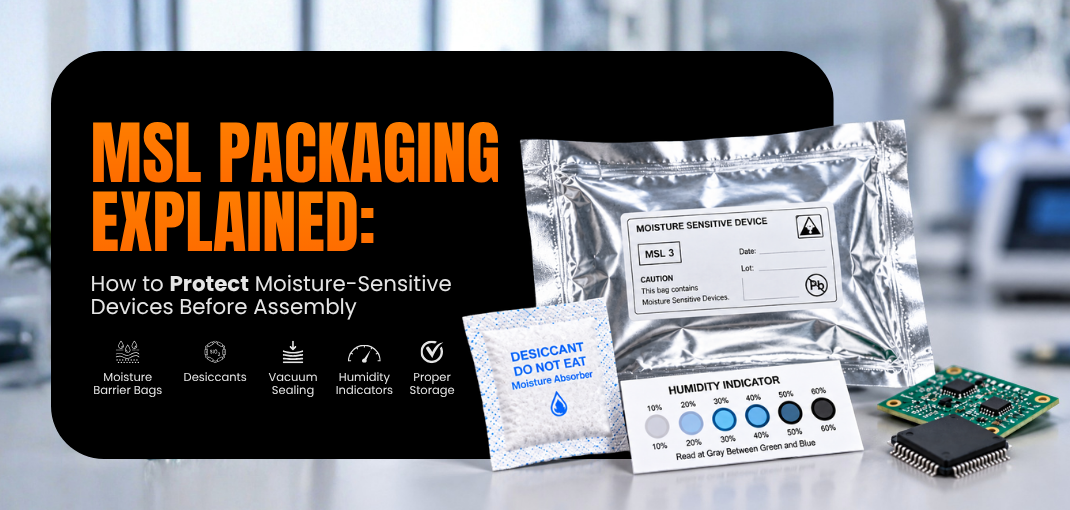
- Moisture barrier bags
- Desiccant
- Humidity indicator cards
- Vacuum sealing
- Proper labeling
- Controlled storage
- Exposure-time tracking
The goal is simple:
Keep moisture-sensitive components within their required moisture exposure limits until they are ready for assembly.
This is particularly important for components that may travel across countries or remain in inventory for extended periods.
What Is a Moisture Barrier Bag?
A moisture barrier bag (MBB) is a specialized packaging material designed to significantly limit moisture transmission from the outside environment into the package.
This is different from an ordinary plastic bag.
A standard plastic bag may provide physical protection, but it is not necessarily designed to provide the moisture barrier performance required for moisture-sensitive electronic components.
MBBs are engineered using barrier layers that reduce moisture transmission.
When properly sealed, they create a controlled environment around the components inside.
For electronics manufacturers, the bag is often one part of a broader MSL packaging system rather than the complete solution by itself.
Why Desiccants Are Used in MSL Packaging
Even after sealing a component inside a moisture barrier bag, some moisture may remain inside the package.
There may also be moisture already present in the components or packaging materials.
This is where desiccants become useful.
A desiccant absorbs moisture within the sealed package, helping maintain a low-humidity environment.
Common desiccant systems used in packaging are designed specifically for moisture control.
However, desiccants have a finite moisture-absorbing capacity.
They are therefore not a substitute for proper barrier packaging.
Think of the system this way:
Moisture barrier bag = slows moisture from getting in
Desiccant = captures moisture inside
Together, they provide much stronger moisture protection than either approach alone.
What Is a Humidity Indicator Card?
A humidity indicator card provides a visual way to monitor moisture conditions inside moisture-sensitive packaging.
The card contains humidity-sensitive indicators that change appearance when exposed to particular humidity levels.
This gives operators an easy way to check whether the package may have experienced excessive moisture exposure.
For production environments handling large quantities of components, this can provide an additional layer of quality control.
Instead of simply assuming that every package remained protected, operators can inspect the packaging system before components are released for assembly.
Where Does Vacuum Packaging Fit Into MSL Packaging?
Vacuum packaging can play an important role in protecting electronic components, but it should be viewed as one part of the overall moisture-control strategy.
A vacuum packaging machine removes air from the package before sealing.
Reducing the air volume also reduces the amount of water vapor and oxygen contained in the package at the time of sealing.
Once the moisture barrier bag is sealed, the package provides a physical barrier against the surrounding environment.
For electronics manufacturers, this combination can be especially useful when components need to be protected during:
- Long-distance transportation
- International shipping
- Extended warehouse storage
- High-humidity conditions
- Inventory holding
- Distribution between manufacturing facilities
The effectiveness of the overall system still depends on using appropriate packaging materials and following the applicable handling requirements.
Vacuum Packaging vs. Standard Sealing for Electronics
There is an important difference between simply sealing a bag and creating a controlled packaging environment.
With standard sealing, the bag may contain a considerable amount of air.
That air contains moisture.
Vacuum packaging removes much of that air before the package is sealed.
This can help reduce the initial moisture load inside the package and limit the amount of oxygen present.
For moisture-sensitive electronics, that can provide an additional level of protection when used with appropriate moisture-barrier packaging.
However, vacuum packaging should not be treated as a replacement for MSL procedures, desiccants, humidity indicators, or manufacturer-specific handling instructions.
It is better understood as part of a layered protection system.
Why MSL Packaging Matters During International Shipping
Electronics frequently cross multiple climate zones before reaching the assembly facility.
A component might leave a dry warehouse, travel through a humid port, spend days inside a shipping container, and then arrive at a production facility where temperature and humidity conditions are completely different.
Those environmental changes can make moisture control difficult.
International transportation can also involve:
- Long transit times
- Temperature fluctuations
- High humidity
- Container condensation
- Warehouse storage
- Repeated loading and unloading
- Extended customs delays
A properly designed MSL packaging system helps isolate components from these environmental changes.
This is especially valuable for manufacturers that source components from overseas suppliers.
What Happens When an MSL Package Is Opened?
Opening the moisture barrier bag changes the situation immediately.
The components are no longer isolated from ambient humidity.
From this point, the manufacturer needs to manage the component according to its MSL classification and applicable handling procedures.
This is where floor life becomes important.
What Is Floor Life?
Floor life refers to the allowable time a moisture-sensitive component can be exposed to specified ambient conditions after its moisture-protective packaging has been opened.
The permitted exposure depends on the component’s MSL classification and the applicable environmental conditions.
For example, a component with a relatively low moisture sensitivity may tolerate considerably more exposure than a highly moisture-sensitive device.
This is why production teams should record when moisture-sensitive packaging is opened rather than relying on memory.
How Manufacturers Can Manage MSL Floor Life
Good MSL management doesn’t have to be complicated, but it needs to be consistent.
A production facility can establish procedures for:
1. Recording When Packages Are Opened
Mark the opening time and date.
This creates a clear starting point for exposure tracking.
2. Identifying MSL Classification
Keep the MSL level visible to operators.
Labels, inventory systems, or production software can help.
3. Controlling Production-Floor Conditions
Maintain appropriate temperature and relative humidity according to applicable requirements.
4. Minimizing Unnecessary Exposure
Don’t open moisture-sensitive packages hours or days before components are actually needed.
5. Returning Unused Components to Controlled Storage
If components cannot be used within the applicable exposure period, follow the manufacturer’s recommended procedures for resealing, drying, or other corrective action.
Dry Cabinets and MSL Components
Dry cabinets are another important tool in moisture-sensitive electronics handling.
A dry cabinet maintains a controlled low-humidity environment where opened components can be stored.
This is useful when components cannot immediately move from packaging into production.
A manufacturer may use a combination of:
Moisture barrier packaging → production handling → dry cabinet → PCB assembly
The exact process depends on the component, MSL classification, facility conditions, and applicable standards.
Vacuum packaging is particularly useful for creating the initial protective package, while dry cabinets can help manage components after that package has been opened.
Should You Use Vacuum Packaging and Desiccants Together?
In many applications, using multiple moisture-control methods makes sense.
For example:
Moisture-sensitive component + moisture barrier bag + desiccant + humidity indicator + vacuum sealing
creates multiple layers of protection.
The barrier packaging limits moisture transmission.
The desiccant captures moisture inside.
The humidity indicator provides a visual monitoring mechanism.
Vacuum sealing removes much of the air before sealing.
The combination can provide a robust packaging approach for sensitive electronics.
However, manufacturers should select the packaging configuration based on the component manufacturer’s requirements and applicable industry standards rather than assuming that more packaging is automatically better.
Common MSL Packaging Mistakes
Even a high-quality packaging system can fail if the process around it is poorly managed.
Using Ordinary Plastic Bags
A standard bag may not provide the moisture barrier performance required for MSL applications.
Forgetting the Desiccant
A barrier bag alone does not necessarily remove moisture already present inside the package.
Not Checking the Humidity Indicator
If the package has been compromised, the humidity indicator may provide an important warning.
Leaving Packages Open on the Production Floor
Once the MSL package is opened, the component begins accumulating moisture according to its exposure conditions.
Poor Sealing
A weak or incomplete seal can allow moisture to enter the package.
Using Damaged Bags
Punctures, cuts, and other physical damage can compromise the moisture barrier.
Ignoring Shipping Conditions
A packaging method that works in a controlled warehouse may not provide adequate protection during long-distance transportation through humid environments.
Not Tracking Floor Life
Without exposure tracking, operators may have no reliable way to determine how long components have been exposed.
Choosing a Vacuum Packaging Machine for MSL Applications
If vacuum packaging is part of your electronics moisture-control process, the machine itself deserves careful consideration.
Not every vacuum packaging machine is equally suitable for industrial electronics applications.
Look at factors such as:
Vacuum Control
The machine should provide consistent and repeatable vacuum performance.
Sealing Quality
A reliable seal is essential because even a small leak can compromise the protective environment.
Repeatability
If hundreds or thousands of packages are processed, consistent results are much more important than simply achieving a strong vacuum once.
Bag Compatibility
The machine should be suitable for the moisture barrier materials being used in the application.
Production Capacity
Consider how many components need to be packaged per hour or per shift.
Operator Control
Simple, repeatable controls can reduce operator variation and improve packaging consistency.
Maintenance
Reliable sealing equipment needs regular inspection and maintenance to keep vacuum and sealing performance consistent.
For high-volume operations, automation may also be worth considering.
MSL Packaging Is About More Than the Bag
One of the biggest misconceptions about moisture-sensitive electronics is that packaging alone solves the problem.
It doesn’t.
MSL protection is a process.
The packaging needs to work together with:
- Correct component identification
- Moisture barrier materials
- Desiccants
- Humidity indicators
- Vacuum or appropriate sealing
- Storage conditions
- Floor-life tracking
- Production procedures
- Reflow requirements
- Operator training
If one part of the process is ignored, the overall protection strategy can be weakened.
For example, a component can arrive perfectly packaged from the supplier but become vulnerable after the bag is opened and the component is left on a humid production floor.
The packaging did its job.
The process failed.
Why MSL Packaging Is Especially Important in Humid Climates
Humidity can make electronics packaging more challenging.
In regions with high ambient humidity, moisture-sensitive components can accumulate moisture more quickly when exposed to the environment.
This makes proper storage and packaging particularly important for manufacturers, distributors, and electronics assembly facilities operating in tropical or coastal regions.
Vacuum packaging combined with suitable moisture barrier materials can help create a controlled environment around components during transportation and storage.
But once the package is opened, environmental control becomes equally important.
That means manufacturers should consider both sides of the equation:
Protect the component before opening.
Control exposure after opening.
A Practical MSL Packaging Workflow
A simple workflow might look like this:
Step 1: Identify the Component
Determine the component’s MSL classification and follow the supplier’s handling instructions.
Step 2: Prepare the Packaging
Use an appropriate moisture barrier bag and the required packaging accessories.
Step 3: Add Desiccant and Humidity Indicator
Place the appropriate moisture-control materials inside the package.
Step 4: Load the Components
Handle the devices properly and avoid unnecessary environmental exposure.
Step 5: Vacuum and Seal
Remove air from the package and create a consistent seal using appropriate equipment and settings.
Step 6: Label the Package
Clearly identify the component, MSL classification, packaging date, and other required information.
Step 7: Store Properly
Keep packaged components in the recommended storage environment.
Step 8: Monitor Before Assembly
Inspect packaging integrity and humidity indicators before opening.
Step 9: Track Floor Life
Once opened, begin tracking exposure according to the component’s requirements.
Step 10: Assemble Within the Allowed Exposure
Move components into the assembly process within the applicable floor-life limits or follow the manufacturer’s corrective procedures.
How Better MSL Packaging Can Reduce Manufacturing Risk
Moisture-related component failures can create costs that go far beyond the price of an individual semiconductor or IC.
A damaged component can contribute to:
- PCB rework
- Production downtime
- Scrap
- Delayed shipments
- Field failures
- Warranty claims
- Customer complaints
- Reduced product reliability
For high-volume manufacturers, even a small percentage of moisture-related failures can become expensive.
Effective MSL packaging is therefore not simply a packaging expense.
It is a form of risk management.
By protecting components before they reach the assembly line, manufacturers can reduce the likelihood of avoidable moisture-related problems.
Final Thoughts: Protect the Component Before It Reaches the Reflow Oven
Moisture-sensitive devices require more attention than simply keeping them inside a sealed plastic bag.
From the moment a component leaves the manufacturer’s facility until it reaches the PCB assembly line, moisture exposure needs to be controlled.
MSL packaging provides the first line of defense.
Moisture barrier bags help prevent moisture from entering. Desiccants absorb residual moisture. Humidity indicators provide a way to monitor package conditions. Vacuum sealing can further reduce the air and moisture present when the package is sealed.
But the process doesn’t end there.
Once the package is opened, floor-life management, environmental controls, proper storage, and timely assembly become equally important.
For electronics manufacturers and distributors, the goal is straightforward: keep moisture-sensitive components dry and protected until they are ready to be assembled.
When the right packaging materials are combined with reliable sealing equipment and disciplined handling procedures, manufacturers can reduce moisture-related risks and improve the reliability of the products they build.
For businesses looking to strengthen their electronics packaging process, the right vacuum packaging system can become an important part of that strategy particularly when components need protection during storage, transportation, and distribution before assembly.