
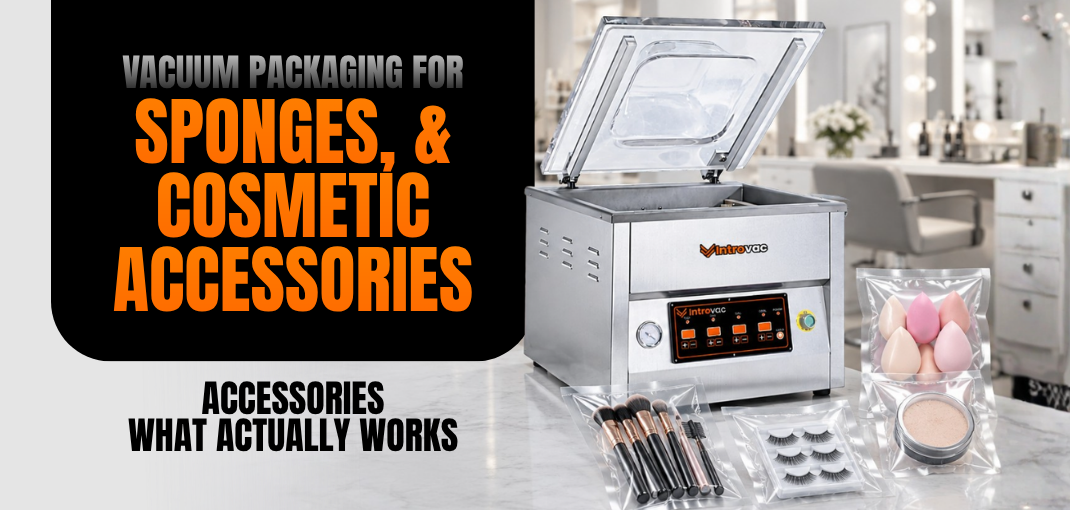
Your makeup brushes arrive dusty. Your beauty blenders get crushed in a loosely packed poly bag. Your eyelash sets shift around in transit and land on the shelf looking handled, not premium.
Vacuum packaging solves a real chunk of that but not for the reason most people assume.
When people hear “vacuum packaging,” they picture food: vacuum-sealed meat, cheese, produce. Extended shelf life, less freezer burn. That’s not really the point for cosmetic accessories. For makeup brushes, sponges, applicators, false eyelashes, and beauty tools, vacuum packaging isn’t primarily about preservation it’s about volume, protection, and consistency.
At Introvac, we work with cosmetic manufacturers and packaging teams evaluating chamber vacuum sealers for exactly this kind of product. This guide covers what vacuum packaging can and can’t do for cosmetic accessories, which products are good candidates, and what to test before you commit a production line to it.
Running a small or home-based beauty brand? Everything below still applies to you, you’re just doing it at a smaller scale with less room for trial and error. Look for the callout boxes throughout for what changes when you’re packaging by the dozen instead of by the thousand.
What Is Vacuum Packaging for Cosmetic Accessories?
Vacuum packaging removes air from a pouch before it’s heat sealed. For cosmetic accessories, the process is straightforward:
- The brush, sponge, applicator, or accessory goes into a suitable pouch.
- The open end of the pouch is positioned inside the chamber vacuum sealer.
- The machine pulls air out of the chamber and pouch.
- Once the target vacuum level is reached, the pouch is heat sealed.
- The chamber returns to atmospheric pressure.
- The sealed package comes out.
The result: a compact, sealed package with far less trapped air than a conventional loosely packed bag.
A chamber vacuum sealer differs from an external suction-style sealer the pouch sits inside the chamber, so pressure inside and outside the bag changes together in a controlled way. That control is what makes chamber sealers the standard choice for repeatable commercial packaging.
Small-batch note: A compact chamber sealer can absolutely handle low-volume runs you don’t need an industrial unit to get consistent seals. What you do still need is testing before you run your full batch, same as a large manufacturer.
Which Cosmetic Accessories Can Be Vacuum Packaged?
Not every beauty product should be vacuum packaged. Here’s how it breaks down by category.
Makeup Brushes
Foundation, powder, blush, eyeshadow, concealer, contour, and kabuki brushes plus travel and professional sets are all reasonable candidates. Vacuum packaging gives brushes a physical barrier against dust and handling during storage and shipping.
The catch: too much vacuum can compress or reshape soft bristles. Test your actual brush design before scaling up the goal is a repeatable vacuum level that protects the brush without flattening it, not the strongest vacuum your machine can pull.
Cosmetic Sponges and Beauty Blenders
Sponges are soft, porous, and highly compressible, which is both the appeal and the risk. Vacuum packaging can dramatically shrink package volume but excessive compression can affect the sponge’s shape or feel when the customer opens it.
Test and document:
- Vacuum level and time
- Sealing temperature
- Pouch dimensions
- How well the sponge recovers its shape after opening
False Eyelashes and Lash Accessories
Lightweight and pouch-friendly, but delicate. Excessive pressure or a poorly chosen pouch geometry can deform lashes or cause them to stick to the packaging. For premium lash lines, also weigh whether a compressed vacuum pouch matches the unboxing experience you’re selling technically possible isn’t always commercially desirable.
Makeup Applicators and Beauty Tools
Wedges, spatulas, tweezers, and small manicure/pedicure tools can be vacuum packaged too, though rigid items won’t shrink the way flexible products do. For these, the main benefit is the sealed barrier itself, not volume reduction.
Why Use Vacuum Packaging for Cosmetic Accessories?
1. A physical barrier against dust and handling A sealed pouch reduces exposure during storage and transit. Important: this is not sterilization. If your product needs validated microbiological controls, that’s a separate process don’t market vacuum sealing as making a product sterile.
2. Reduced package volume Flexible products like sponges carry a lot of trapped air in conventional packaging. Removing it shrinks the footprint which can help with carton space, warehouse storage, and shipping costs. Savings vary by product, pouch, and shipping method, so don’t assume a flat percentage until you’ve tested your own SKU.
3. Protection through a multi-stage supply chain Manufacturer → warehouse → distributor → retailer → consumer is a lot of handling. A properly sealed pouch adds a layer of protection at every stage, which matters most for bulk or international shipments.
4. Repeatable commercial packaging A chamber vacuum sealer supports programmable, consistent cycles vacuum time, vacuum level, seal time, seal temperature. That consistency is the real value at production scale, more than any single-unit benefit.
Small-batch note: Consistency matters at 50 units too, just for a different reason it’s what makes your product look intentional and professional instead of hand-packed. Even a basic chamber sealer with saved settings gets you this.
Does Vacuum Packaging Make Cosmetic Accessories Last Longer?
Not automatically and don’t claim it does. Shelf life and durability depend on material, manufacturing process, storage conditions, and handling, not just whether air was removed from the bag. For some products, reduced air exposure helps. For others, the real win is simply the sealed barrier. Avoid blanket shelf-life claims in your own product marketing; they don’t hold up product to product.
Vacuum Packaging vs. Conventional Packaging
| Consideration | Vacuum Packaging | Conventional Packaging |
|---|---|---|
| Air removal | Yes | Usually no |
| Package volume | Can reduce significantly | Usually larger |
| Dust protection | Sealed pouch | Depends on package |
| Product visibility | Depends on pouch | Often excellent |
| Compression | Higher | Usually lower |
| Premium presentation | Product-dependent | Often easier |
| Shipping efficiency | Potentially better | Product-dependent |
| Production cost | Higher equipment/process needs | Often simpler |
A luxury brush brand selling through a retail box may lean conventional, because unboxing is part of the product. A company shipping thousands of sponges to distributors likely benefits more from vacuum’s compactness. There’s no universal winner the right call depends on what you’re optimizing for.
Choosing the Right Vacuum Pouch
The pouch matters as much as the machine. A vacuum sealer can perform flawlessly and the package can still fail if the pouch is wrong for the job.
- Thickness: Thin material is more prone to punctures, especially with brush handles or tools with sharp edges.
- Barrier properties: Vacuum alone isn’t a moisture or oxygen barrier the pouch material does that work.
- Sealability: The pouch needs to form a reliable seal at your machine’s actual operating settings.
- Visibility: Clear film lets retail customers and inspectors see the product before opening.
- Size: Don’t oversize the pouch “just in case” extra material makes positioning and sealing less reliable, not safer.
How to Choose the Right Vacuum Level
More vacuum is not automatically better. Over-compression can flatten sponges, distort bristles, or pull loose particles toward the seal area, weakening it.
Determine vacuum level through testing evaluate the package immediately after sealing, and again after storage and transport simulation. Watch for:
- Deformation or broken bristles
- Compressed sponge structure that doesn’t recover
- Pouch leakage or seal contamination
- Product sticking to the film
- Difficulty opening the package
Aim for a reliable process, not the strongest possible pull.
A Typical Commercial Vacuum Packaging Workflow
- Product prep inspect and stage the item
- Pouch loading place the product in a compatible pouch
- Chamber loading position the open end across the sealing bar
- Vacuum cycle air is pulled from chamber and pouch
- Heat sealing the pouch seals once target vacuum is reached
- Pressure return the chamber returns to atmospheric pressure, and the pouch conforms to the product
- Inspection check seal integrity and package condition
- Secondary packaging into cartons, retail boxes, or shippers as needed
This cycle is designed to repeat consistently at production scale which is the whole case for a chamber sealer over hand-sealing individual bags.
Common Problems (and Fixes)
| Problem | Likely Cause | Fix |
|---|---|---|
| Product deformation | Vacuum too strong for the material | Lower vacuum level, retest recovery |
| Particles reaching the seal | Loose material migrating during the cycle | Improve positioning and pouch design |
| Weak seals | Wrong pouch material, contamination, bad temp/time | Validate pouch, recalibrate seal settings |
| Pouch punctures | Sharp edges or hard components | Upgrade film strength or add inner protective packaging |
| Excessive compression | Vacuum intensity too high for the product | Reduce vacuum or reconsider the packaging method |
| Weak retail presentation | Compressed look doesn’t match brand positioning | Use vacuum as an inner layer, add conventional secondary packaging |
Is Vacuum Packaging Right for Your Products?
Consider it when you need: reduced package volume, individually sealed units, dust/handling protection, more efficient transport, or consistent commercial sealing at scale.
Stick with conventional packaging when: appearance drives the sale, the product is highly delicate, compression risks damage, or retail unboxing matters more than volume savings.
There’s no single right answer for every accessory the right approach comes from testing your specific product on the pouch and equipment you intend to actually use.
Best Practices Checklist
- Test the actual product don’t assume brushes, sponges, and applicators behave the same way.
- Start with moderate vacuum settings and increase only if testing supports it.
- Choose your pouch for the application: thickness, barrier, sealability, puncture resistance.
- Keep the sealing area clean dust and residue compromise seal quality.
- Validate seal strength, not just seal appearance.
- Check compressible products for shape recovery after opening.
- Weigh retail presentation, not just packaging efficiency.
- Test under realistic storage and transport conditions, not just fresh off the line.
FAQ
Can makeup brushes be vacuum sealed? Yes, using suitable pouches and a chamber vacuum sealer but test vacuum pressure first, since excessive compression can affect bristle shape.
Can beauty sponges be vacuum packaged? Yes, and it can meaningfully reduce package volume. Because sponges are compressible, confirm they recover their shape after opening before committing to a vacuum level.
Does vacuum packaging sterilize makeup brushes? No. It’s a sealing and protection method, not a sterilization process. Validated sterilization requires a separate, appropriate process.
What vacuum level should I use for makeup brushes? There’s no universal setting it depends on bristle material, handle design, pouch, and desired final look. Determine it through testing, not by copying another product’s settings.
Can vacuum packaging reduce shipping costs? Potentially, for products that compress significantly, like sponges and flexible accessories. Actual savings depend on your package dimensions, carrier pricing, and product density.
Does vacuum packaging protect against moisture? Removing air helps, but moisture protection mostly comes down to the pouch material and seal integrity don’t market vacuum packaging as moisture-proof on its own.
Where to Start
Vacuum packaging isn’t a universal upgrade it’s a tool that fits some products very well and others not at all. Soft sponges often see the biggest volume reduction. Brushes need a gentler touch to protect bristles. Hard tools benefit more from the sealed barrier than from compression. Premium retail lines may need vacuum as an inner layer under conventional presentation packaging.
The fastest way to know if it works for your product is a trial run: your actual accessory, your intended pouch, and a chamber vacuum sealer set to realistic production parameters.
Introvac works with cosmetic manufacturers to run exactly this kind of trial from selecting the right chamber sealer for your volume to dialing in vacuum and seal settings for your specific product. [Talk to our team about a packaging trial →]